

Two months ago we described a market priced for perfection and narrowly led. In August, the strain has migrated to US Treasuries themselves, and the official response has moved from private discussion to public action. Two coordinated interventions inside twenty days — one in the currency market, one on the long end of the Treasury curve — could be the early days of a reserve-currency wobble. Our monthly mainly discusses this major event along with our suggested allocation.
The failure zone moves from equities to sovereign paper
The single most important development of August was not in equities. It was the appearance of coordinated official intervention to defend US bond and currency markets — and the strategic signal that intervention now sends, whatever its arithmetic effect.
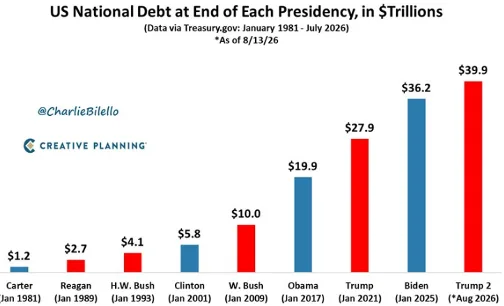
The month opened with a historic monetary intervention: the US and Japan acted jointly to support the yen, on a scale not seen in more than thirty years. Framed publicly as a currency operation, the true motive sat on the Treasury side. Japan is one of the largest foreign holders of US paper; a disorderly yen adjustment forces Japanese institutions to sell US assets, particularly Treasuries, to repatriate. To keep that lid on, Washington effectively bailed out Tokyo — and, in an unusually revealing detail, sold euros rather than dollars to fund the operation. This is what the accounts look like when a debtor country cannot afford to let its major creditors reduce exposure. The national debt is up $3.6 trillion in thirteen months.
| Fig. 1 – US national debt |
 |
| Source: Creative Planning |
The bigger message came three weeks later, and it deserves careful reading. On 19 August, Treasury Secretary Bessent announced that the buyback programme for outstanding long-dated Treasuries — specifically the 10-20 year and 20-30 year sectors — would be at least doubled from $2 billion to $4 billion per operation, with the first expanded operation scheduled for early September. The framing was deliberate, and on its own terms defensible. This is not debt monetization. Treasury is simultaneously issuing enormous quantities of new debt (figure 1) — roughly $739 billion of privately-held net marketable borrowing across the July-September quarter alone. In cash-flow terms the mechanism is: issue new debt, receive cash, buy back selected older off-the-run bonds.That is debt management, and Bessent has repeatedly cited comparable practices used in Europe and Japan
Two things are true simultaneously, and both matter. First, $4 billion buybacks are tiny relative to a $30 trillion Treasury market and cannot cap yields on their own — which is why 30-year yields rallied briefly on the announcement and then faded back toward their pre-announcement levels within days. Second, the announcement itself is the message. The US Treasury has now formally declared its willingness to act as a marginal buyer of the long end when functioning is strained; and the missing third layer of Bessent’s package — a credible fiscal-consolidation plan — has been pushed back by months on the acknowledged political difficulty of spending cuts. What remains is: huge deficits, enormous issuance, upward-drifting long yields, and a Treasury now explicitly reserving the right to intervene against those yields. The technically correct label for the buyback expansion is “liquidity backstop”. The consequential question is whether it is also the thin end of a broader strategy to manage the term premium without formally conducting monetary policy. If so, the implications for the currency, for real yields, and for anything with a claim on a fixed physical asset base are considerably larger than $4 billion per operation would suggest.
The AI credit crack becomes visible
The warning signals we flagged in the July note — hyper-scaler bond spreads at 2022-crisis levels — became something more concrete in August: outright credit distress in the largest AI names, and a token economy that is disinflating at exactly the wrong time.
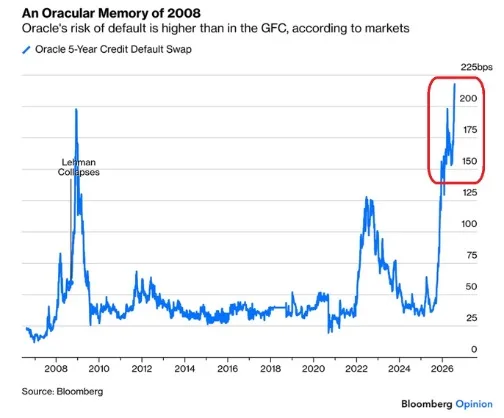
Oracle’s 5-year credit default swap reached a record ~215 basis points, implying a default probability above 16% and surpassing its peak during the 2008 Financial Crisis (figure 2 overleaf). Unlike the capital-light tech booms of the past, today’s hyper-scalers carry both massive leverage and ongoing, unavoidable power and compute costs — making them, on a marginal-cost basis, roughly 80% riskier than the median investment-grade peer. And yet the capex continues, driven more by fear of falling behind than by returns visible today. On the demand side, the picture is deteriorating in the way that matters most: the effective cost of intelligence has fallen further, largely on the back of Chinese open-weight competition, with token prices now back to where they stood at the start of the year. This is precisely the variable we identified in June as the entire bull case’s single point of failure. The equity market, however, has doubled down: a basket of the largest AI-related ETFs now accounts for a record ~19% of all US ETF trading volume, up from just 4% at the start of 2026 and double the previous 2024 peak. On a leveraged-ETF base already concentrated in the same names, this is not diversified enthusiasm — it is a queue.
| Fig. 2 – Oracle risk goes parabolic |
 |
| Source: FED |
A midmonth calm — and a vote of confidence at the end
The middle of the month delivered a brief pause; the end of it delivered something more meaningful, in an asset class we normally treat tactically.
The VIX closed at 14.20 on the second Friday of the month and printed a 15.3 handle the following Monday Neither number requires a catalyst to hold, and we would not underestimate 2017’s example — implied volatility can stay pinned for months. But buying vol at 14 with sovereign-paper interventions failing behind it is asymmetric enough to be sensible even without a specific trigger.
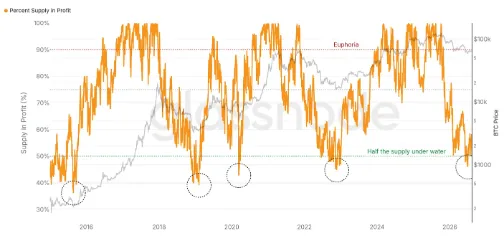
In digital assets, the setup was similarly ambiguous mid-month: barely half the Bitcoin supply was above water at prevailing prices, and the Puell Multiple (on-chain indicator that measures current miner revenue relative to its 365-day average) had fallen to roughly 0.7, placing miner revenue well below its 365-day average — yet the Miners’ Position Index at -1.2 showed outflows remained subued. Miners were stressed but not capitulating.
Shorting the asset in a price band from which it has bounced every prior cycle is not our idea of an edge. By month-end that patience paid: Bitcoin rebounded once the Bessent announcement was digested.
| Fig. 3 – Bitcoin reversals |
 |
| Source: FED |
We would treat that rebound as more than a mechanical response to a small liquidity operation. Bitcoin has, in every episode of visible monetary or fiscal stress since its inception, functioned as a real-time vote of confidence — or the withdrawal of it — in the conduct of the two policies. A Treasury reserving the right to buy back its own long end, in the same month that a coordinated FX intervention was needed to stop that paper being sold by the second-largest foreign creditor, is exactly the kind of setup that historically produces such a vote.
Positioning: from stepping back to stepping into hard assets
Our July stance was to reduce equity exposure and add long-duration Treasuries. In August we kept the first half and reversed the second — the Bond Vigilantes are winning, and the tape confirms it.
We are now out of our tactical long duration. IEF, which we added in July on the view that the sell-off north of 4.5% was overdone, is a position we no longer hold on a directional basis. This is a genuine change of view, and it costs us the carry — but the fiscal picture, the failed FX intervention, and the strategic signaling of the buyback expansion together make the risk-reward asymmetric in the opposite direction from where it stood four weeks ago. The rotation went into things that cost money to make.
In equities, we entered Invesco Aerospace & Defense (PPA), following a clean technical breakout that has also confirmed on the iShares equivalent, ITA. We opened a position in a Turkey ETF on the dollar leg, on the view that the return of orthodox monetary policy is a genuine structural change from the Erdogan-era experiment and is not yet priced. We hold long Brazil. The macro regime allocation now favors credit, dividend, insurance and communication services, and we have opened a trend-follower structure alongside deployed with ETFs such as DBMF. The most important rotation, in our view, is thematic: if you believe the AI capex build-out will continue regardless of whether the equity names deliver returns, the cleanest expression is not the hyper-scalers or the semiconductors — it is the energy sector that must power them. We are building a basket around XLU, URA and GRID as our expression of that view.
Structurally, Bitcoin retains its role as the market’s cleanest referendum on monetary and fiscal credibility, and we would view sustained strength there as confirmation of the same thesis that drives the rest of our hard-asset rotation.
We are not calling a crash. We are calling something that historically comes before crashes and rarely after them: an environment in which two coordinated official interventions inside twenty days fail to hold the tape, and the third leg of the response — genuine fiscal consolidation — remains conspicuously postponed. The 1965 analogue still applies to equities. But the reserve-currency analogue — Sterling in the late 1960s, or a slow-motion emerging-market repricing — is now the more useful frame for the sovereign leg. We continue to rotate accordingly.