
Last month we described a market priced for perfection, narrowly led and structurally fragile, and explained why we had begun, deliberately and without drama, to step back. July delivered the second instalment of that unwind. The tension we flagged in June – a disinflation scare colliding with a hawkish Fed – has now sharpened. Core inflation, once shelter is stripped out, has been running at target for three years. The labor market is breaking in the ways it usually does before recessions, not during them. And yet the Fed remains publicly focused on a war it may already have won. Beneath the tape, the market’s plumbing – credit spreads, brokerage balances, positioning, leverage – has begun to speak with a different voice than the price index.
The rates debate returns
The most under-appreciated development of the month was the quiet flip in the direction of the next Fed surprise: away from a hike, toward a cut.
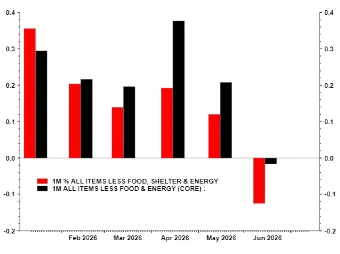
Strip shelter – the noisiest and most lagged component – out of the CPI basket, and headline inflation ex-food, energy and shelter fell 0.1% in June after a 0.1% rise in May, following subdued readings through the spring; the year-on-year print sits at 2.1%, and has been within a hair of 2% for three years (figure 1).
| Fig. 1 – Core inflation under control |
 |
| source: Socgen |
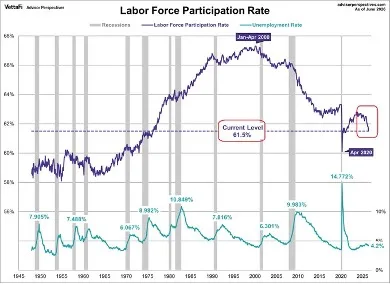
The labour market has done what it does when a cycle turns rather than pauses: the US prime-age (25-54) participation rate fell 0.6 percentage points in June, the second-largest monthly drop since the 1940s outside the April 2020 shutdown, and the total labor force lost 720,000 people (figure 2). Wage growth touched a cycle low of 3.56% in May and real wages remain in compression at -0.6% — both historically leading, not lagging, indicators of demand.
| Fig. 2 – Labor market is not strong |
 |
| source: FED |
Against this, this did not come as a surprise that the Fed Fund futures assigned a 33.7% probability to a rate hike and that the FED did not hike interest rate. Now, we hear that the FOMC continues to insist inflation matters more than financial conditions. That is not a stable equilibrium. The transmission chain we watch — ISM manufacturing leads EPS revisions, China’s credit impulse leads US manufacturing on roughly a twelve-month lag — is signaling further softening ahead. If that path is right, the Fed will not choose to cut; the equity market will force it to. We continue to fade the rate-hike narrative — a stance that has now paid for more than two years.
Priced for a perfection that keeps moving further away
As the macro backdrop softens, the earnings bar the market is asking companies to clear has moved to levels without precedent.
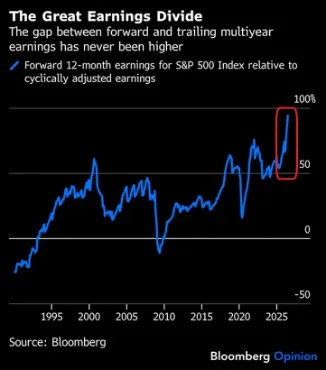
| Fig. 3 – Consensus earnings are strong |
 |
| source: Bloomberg |
Consensus 12-month forward S&P 500 earnings have reached $365 per share against a cyclically-adjusted figure — inflation-adjusted 10-year earnings — of $188 (figure 3). The gap of more than 90% is the widest on record; the comparable spread at the 2000 dot-com peak was roughly 65%. Trailing earnings already exceed cyclically-adjusted earnings by more than 60%, against a long-run average of 11% since 1881. This is not confined to the mega caps: the Russell 2000 forward P/E has climbed to about 33x, above its 2000 peak, with nearly 40% of the index still unprofitable. And the “most hated bull market in history” is simultaneously pricing the most optimistic long-term earnings growth in history. It is a difficult combination to defend intellectually, and an easy one to disappoint.
The AI keystone shows first structural cracks
Strip away everything else, AI still governs the tape, but the plumbing that carries it is now issuing warnings the equity indices have not yet acknowledged.
The most striking of these is credit. Long-dated bonds issued by the hyper-scalers to fund the AI build-out are trading at spreads not seen since the 2022 bear market, in some cases approaching BB-rated junk territory despite their investment-grade ratings. This is unusual and it is quiet: bond investors, who tend to see problems earlier than equity investors, are demanding to be paid materially more to fund the same names whose equities remain near all-time highs. Free cash flow at the hyper-scalers is forecast to turn negative next year. And the reflexive loop at the center of the trade is starting to look uncomfortably familiar: Nvidia is now investing directly in the customers who then use the money to buy its chips — a 2026 rhyme of the 2007 vendor-financing pattern that ended the last capex-led semiconductor cycle. Concentration in retail structures is proportionate to the narrative: the Nasdaq 100 and semiconductors together account for roughly $87 billion of leveraged-ETF assets, more than every other tracked asset combined, including single names like Nvidia and Tesla and including bitcoin. Hedge funds spent the middle of the month selling US tech into strength and into rising volatility. None of this is decisive on its own. Together, they describe a keystone under load.
Positioning is fragile and no longer provides a cushion
The reassuring image of a “wall of worry” – cash on the sidelines waiting to be deployed – has been quietly hollowed out.
Net credit balances in US brokerage accounts, which measure investor cash relative to margin debt, fell another $70 billion in June to -$1.06 trillion, an all-time low; the metric has collapsed by roughly $800 billion, or about 300%, from the 2022 bear-market trough. Margin debt itself climbed $86 billion to a record $1.53 trillion, its third consecutive monthly increase. Cash at BofA private clients has fallen to 10% of assets against a twenty-year average of 12% — a small number that hides a large behavioral shift: clients did not choose conviction, they simply exhausted the discipline of holding cash while everything else went up. Meanwhile the profit picture underpinning the whole valuation edifice is not being shared: the rise in US corporate margins over the past two years has been almost entirely a large-cap story
Positioning: continuing to step back
Our conviction list has narrowed, but it has not emptied.
Gold’s structural bid remains a clean story. Central banks now hold about 25% of their reserves in gold, up from a historic low of 10% in the 2015-2020 window and still well below the 40-60% that prevailed from 1970 to 1990. Official-sector purchases added another 41 tons in May, the largest monthly addition since November 2025, and China’s spot gold ETF has now overtaken every equity ETF to become the country’s largest fund of any kind. We continue to hold gold long and have added a paired short in silver at a 0.4 ratio, expressing the view that today’s demand is a monetary-anchor story rather than a broader precious-metals story. The wider commodity complex, via the Bloomberg Global All Commodity index, remains in a well-defined uptrend channel that has just held support after several consecutive weekly drops.
Through July we did what we said in June we would do: kept reducing, deliberately and without alarm.
We were fully out of the reflexive AI expressions we began cutting in the second half of June. We added DBMF and IEF, kept our long gold / short silver ratio pair, and hold our copper and broader metals-and-mining exposure. We remain constructive on China as it bottoms, and we treat bitcoin with respect rather than enthusiasm – the miner-stress composite has just entered its “undervalued” range for the first time this cycle, a signal that has historically preceded major bottoms but is not an invitation to size up until price confirms. We are not calling a crash. Last month we suggested that the more instructive analogue for what lies ahead is not 1929 but 1965 – no headline, no panic, simply a decade of flat real returns that quietly erased a generation’s compounding. July’s data compounded that view. A market priced for perfection, narrowly led, structurally fragile and now visibly stretched at the positioning and credit levels does not require a catalyst to disappoint; it requires only the absence of perfection. We will use whatever strength the tape provides – and Washington will provide it where it can – to keep stepping back.