

Last month we argued that the market’s calm was borrowed, not earned — that an extreme positive-gamma configuration, of the kind that preceded the late-2021 top, would not unwind gradually. June delivered the first instalment of that reversal. Two macro crosscurrents framed the month: a fast-moving disinflation scare colliding with a newly hawkish Federal Reserve, set against the most expensive US equity market in 125 years — a market whose entire bull case now rests on a single variable, the price the world is willing to pay for artificial intelligence.
This note traces how the four supports of this rally — valuation, the macro backdrop, leadership, and market structure — were tested through June, and explains why we have begun, deliberately and without drama, to step back.
Priced for perfection, and narrowly led
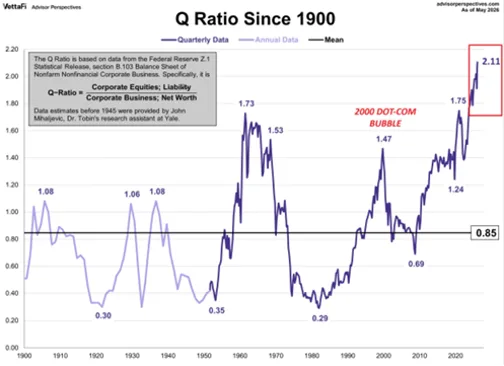
The US equity market enters the summer more expensive, on the broadest measures, than at any point in living memory.
| Fig. 1 – Tobins’Q Ratio: the most overvalued US market in 125 years |
 |
| source: VettaFi |
Tobin’s Q — the total market value of US corporations against the replacement cost of their assets — reached 2.11, its highest reading since the series began in 1900 and roughly 149% above its long-run average of 0.85. Investors are, quite literally, paying more than twice what it would cost to rebuild these companies from scratch. As we have written before, expensive is not synonymous with overvalued: a record multiple is sustainable so long as margins hold and rates stay contained, and the margin picture remains genuinely supportive — the S&P 500’s net margin is forecast to rise from 14.5% today toward 16.7% by 2027, arguably the most bullish chart in this market. But a Q ratio at this level removes the cushion. It is not a timing signal; it is a statement about the cost of being wrong.
The macro pivot: a disinflation scare meets a hawkish FED
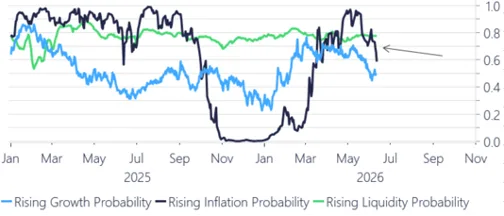
The dominant macro development of June was a sharp downturn in US inflation nowcasts — a reversal that arrived faster than almost anyone was positioned for.
| Fig. 2- US macro regime: inflation risk rolling over |
 |
| source:SR |
Early in the month the data still pointed the other way: PCE at +3.8% year-on-year, the personal savings rate at a post-2022 low of 2.6%, a consumer visibly stretched. Within a fortnight the signal flipped — real-time inflation gauges rolled over hard and hiring intentions collapsed, with only 9% of small firms planning to add staff, the weakest reading outside the pandemic in a decade. We read the labour market as genuinely softening; the household survey has told that story for months, and February’s benchmark revision — which cut 2025 payroll growth from +584k to +181k — vindicated it. Against this, the newly reconstituted Fed struck a deliberately hawkish posture, holding at 3.50–3.75% and insisting that inflation now matters more than financial conditions. That is the tension worth trading: official rhetoric is fighting a war the real-time data suggests is already being won. We continue to fade the rate-hike narrative — a stance that has paid for two years and, in our view, remains intact.
The keystone: the price of intelligence
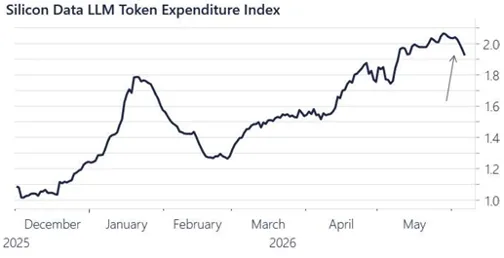
Strip away the macro noise and one variable now governs this market: what the world is prepared to pay for a million tokens of inference.
The chart we keep returning to is the Silicon Data LLM Token Expenditure Index — an expenditure- and usage-weighted measure of the effective price of large-language-model inference. It is not raw volume; it captures the mix, rising when usage migrates toward premium frontier models and falling when it drifts to cheaper open-weight alternatives. It is, in effect, the revenue line of the entire AI complex, and everything downstream — the memory trade, the hardware names, the data-centre build-out — is a leveraged bet on that line continuing to climb. So far it has, and the options market agrees emphatically: skew has never been more bullish on semiconductors, nor more bearish on gold. That is precisely what makes it dangerous. When an entire market structure rests on a single variable, the variable ceases to be a strength and becomes the single point of failure. If token pricing rolls over, the bull case does not weaken — it ends.
| Fig. 3 – Silicon Data LLM Token Expenditure Index (SDLLMTK): the price of AI |
 |
| source:SR |
When the calm breaks: gamma and the quiet exist of funds
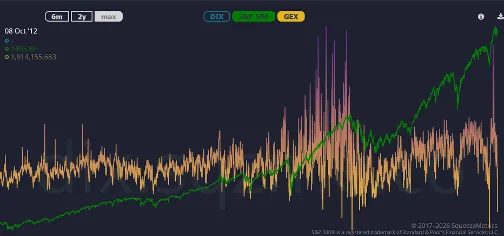
Last month we warned that the market’s stability was borrowed and that, when the reversal came, it would not be gradual. June began to settle that account.
| Fig 4: S&P500 gama has collapsed: from stabilizer to amplifier |
 |
| source: Squeezematrics |
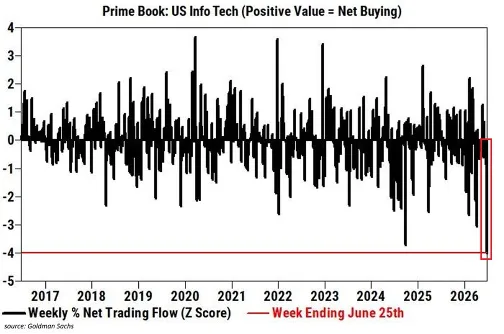
The positive-gamma configuration we flagged in May — dealers mechanically dampening every move — has given way. By month-end, S&P 500 gamma had collapsed, flipping market makers from volatility-suppressors to volatility-amplifiers: selling into weakness and buying into strength, the precise opposite of the stabilising regime that held prices aloft through the spring. Beneath it, the smart money was already moving. Hedge funds sold US information-technology stocks in the week to 25 June at the fastest pace in the decade the data has been kept — exceeding even the August-2024 episode that took the Nasdaq down more than 10%. And the generals are wavering: Nvidia’s ratio to the Nasdaq sits on long-tested support, the line that divides “still leading” from “losing leadership.” None of this is yet a decisive break. But the positioning that read as a reassuring “wall of worry” earlier in the month — retail in puts rather than calls, institutions net underweight despite record index levels — looks less like dry powder and more like the first footsteps toward the door.
| Fig 5: Hedge funds sold US tech at the fastest pace since 2016 |
 |
| source: GS |
Positionning: stepping back, not stepping out
Our response has been to reduce, deliberately and without alarm.
Through June we rotated progressively out of the most reflexive expressions of the AI trade — trimming generative-AI and robotics exposure back toward short-dated cash — while keeping the convictions that do not depend on a single narrative: long copper and the broader metals-and-mining complex, constructive on China as it bottoms, and a defensive sleeve of managed futures that profits if trends turn. Gold we hold flat, having faded its momentum; bitcoin we treat with respect rather than enthusiasm, conscious that a break of key support would open a far lower air-pocket. We are not calling a crash. The more instructive analogue is not 1929 but 1965 — no headline, no panic, simply a decade of flat real returns that quietly erased a generation’s compounding. A market priced for perfection, narrowly led, and structurally fragile does not require a catalyst to disappoint; it requires only the absence of perfection. We expect Washington to defend the tape into the symbolism of the 4 July semiquincentennial — and we intend to use whatever strength that defence provides to keep stepping back.